- group B strep + (boooooo) will write more on this below
- internal exam to check dilation and effacement next week
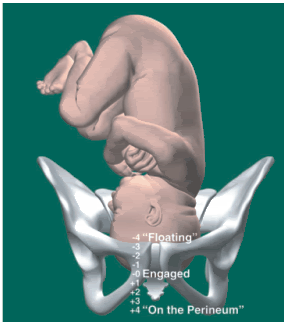
- baby seems to have dropped a bit more, head doesn't wobble as much as it did last week
- because Dr is away for my entire 40th week and a bit before that, he's scheduled me for another ultrasound to assess size, fluid, and position just in case I deliver before he's back (so the on call Dr has all that info)
- heart rate normal
- BP normal (after checking with the original cuff, it read 140/whatever, so he rechecked with a bigger cuff and it read 118/whatever lol)
- fundal height 37cm
- fundal height puts baby at about the 60th%ile for growth according to the Dr's charts and has been in normal the whole time
- Dr estimating I'll deliver a 7.5lb baby (I doubt it... expecting 8.5ish)
- Dr estimating I'll deliver shortly after he comes back from vacation (Oct 1+ at 41+ weeks)
- REALLY REALLY hoping to deliver before Oct 4ish because the thought of feeling like I need to entertain MIL and SIL while in the hospital trying to learn how to feed/bathe/diaper my baby is just killing me... delivering by the 4th would mean I should be out by the 6th if all is good and they're arriving on the evening of the 5th.... plus if I deliver before they arrive, there will be no drama if they decide they are above the rules that we set for our stay in the hospital
- inductions for my Dr would start at about 11 days after your due date which in my case would be the 5th and there is a possibility of being bumped for someone who's having complications if I'm just a normal post term with no complications... that might mean that MIL/SIL wouldn't get to see baby
What being positive means for my labour:
- go to hospital AS SOON AS my water breaks
- IV antibiotics at least twice 4 hours apart during labour
- if water doesn't break before labour, go in with the 5-1-1 rule like normal
So it really doesn't mean much for my labour except I have to get an IV... which is a huge PITA considering my hospital doesn't do routine IV's for natural labouring moms (except for epidurals, pitocin, dehydration or c-sections). Hopefully I can get a heplock so I don't have to be all corded in between doses.
Info on group B strep:
What is Beta Strep, or Group B Strep? Group B Strep, or GBS is a type of bacteria commonly found in the intestinal tract, rectal, or vaginal areas. Up to 30% of women have these bacteria in their vaginal flora at one time or another. Most of the time this bacteria lives in balance with other bacteria and is considered normal, however if it grows out of balance or travels to other parts of the body, such as the blood stream, the urinary tract, or meninges, problems could occur.
How Can GBS affect my pregnancy or my baby? Pregnant women infected with GBS could develop urinary tract infections, amnionitis, or endometritis. Amnionitis could cause the membranes to rupture prematurely, resulting in a pre-term baby. GBS disease could also cause a stillbirth. In most cases, however, women with GBS colonization remain asymptomatic and are only carriers of the bacteria.
If a woman is a carrier, the concern is the possibility of the baby contracting the bacteria as he/she passes through the birth canal or before birth if the membranes rupture and the bacteria passes into the amniotic fluid. Most babies exposed to GBS during birth have no symptoms and do not contract any illness, but in some cases Early Neonatal Group B Streptococcal Septicemia (ENGBSS) could result. Here, GBS bacteria infects the bloodstream and could potentially spread to the meninges (water which surrounds and protects the brain) resulting in meningitis. This could lead to brain damage or death in the baby. Other effects of the disease in babies include pneumonia, cerebral palsy, hearing or vision loss, and learning disabilities. A premature infant is at much higher risk than a full term baby of developing ENGBSS.
Most cases of GBS infection in babies are of the early onset type, which occurs within the first week of life, and often within the first 24 hours. There is also a late onset type, which is the type that most often results in meningitis and this can occur after the first week up until about three months of age. Late onset of GBS infection is only caused by exposure during birth 50% of the time, and the rest of the time is unknown.
What are the signs and symptoms of GBS in an infant?The first four to six hours after birth are the most crucial time for acute observation. Signs and symptoms to watch for are problems with temperature regulation, breathing problems and grunting sounds, fever, seizures, and stiffness or extreme limpness. All of these will be carefully monitored by your health care provider.
How often does GBS infection affect people?Different sources off different statistics on GBS infection. The Group B Strep Association estimates that 8000 babies each year in the US contract serious GBS disease, and that of these 800 will die. Another source sites that 300 babies die each year from GBS disease. The CDC estimate that the risk of a baby contracting GBS disease is .5/1000 births. Although all sources agree that it is a very small number of babies affected, strict protocols have been written by the CDC that affect an extremely large number of women and their babies.
What is the current protocol?
In 2002 the CDC wrote new GBS protocols that call for all pregnant women to have a rectal/vaginal culture to detect GBS between 35 and 37 weeks and for those who test positive to receive I.V. antibiotics during labor if certain risk factors develop that would increase the baby's chances of developing ENGBSS. These risk factors are:• Preterm Labor(less than 37 weeks)• Rupture of membranes before 37 weeks• Rupture of membranes for more than 18 hours• Temperature in mother higher than 100.5 during labor• GBS found in urine
Problems with current Protocol
One problem with the present protocol is that GBS colonization can come and go. A woman, who tests positive at 36 weeks, could become negative by the time she goes into labor as her body creates its own balance yet she will still be considered positive and receive treatment. And vice versa, she could test negative and become positive by the time she starts labor and go untreated.
This present protocol has led to 1/3 of all pregnant women and their babies being treated with I.V. antibiotics during labor which has caused and increase in antibiotic resistant bacteria, not just in GBS strains but other bacteria such as E. coli. This has led to an increase in babies being infected by other bacteria as well as some strains of GBS which are resistant to all know antibiotics.
A study of 43 newborns with blood infections caused by GBS and other bacteria found that when the mother was treated during labor with I.V. antibiotics, 88-91% of the infants' infections were resistant to antibiotic treatment. In mothers not treated during labor 18-20% of the infections were resistant.
Another less serious effect of the I.V. antibiotics is that they also wipe out the natural, healthy flora in the mother's (and baby's) body creating an environment for unhealthy flora like Candida to grow. Thrush, an infection of Candida in a baby's mouth, has become rampant since the development of this protocol.
Allergic reactions to antibiotics are also a real concern. Ten percent of mothers will have a mild reaction and one in 10,000 will experience anaphylactic shock, a severe allergic reaction to the antibiotics which threatens the lives of both mother and baby.
In women who test positive for GBS and receive no antibiotics, less than 1% of babies will become ill from GBS infection according to CDC estimates. Are these dangerous protocols truly worth it?
Are there alternative protocols?
The effectiveness of herbal therapies on GBS has not been scientifically proven and most likely won't as the drug companies won't benefit from herbal treatments for disease. However, it must be assumed that if a woman carries GBS in her body, she also carries the antibodies which will also be pass to the baby. There are herbal which could support this natural immune response in the body and keep GBS in check.
The following is an herbal regimen the mother could use during the 5 weeks prior to her due date:
• Echinacea-tincture or tea once per day• Garlic- 1 clove or 6-8 capsules per day• Vitamin C- 1000 mg/day• Probiotics- daily, follow directions on bottle• Vitamin E- 400 IU per day
This protocol can be used by women who choose not to be screened but are still concerned about GBS or by women who have tested positive for GBS but who choose to have a home birth and no antibiotic treatment, or those who just want to treat prophylactically(not testing but want to just make sure).
Another safe alternative treatment that can be used during labor is rinsing the vaginal and rectal areas with Hibiclens solution every 4-6 hours until baby is born. Hibiclens is the brand name for chlorohexidene, an antiseptic solution that is safe for both mother and baby yet very effective in reducing the incidence of GBS and E. coli infection in newborns. Unlike the herbal regimen recommended above, there have been specific scientific done which have proven the efficacy of this treatment (J Matern Fetal Neonatal Med 2002 Feb; 11 (2) :84-8 and British Journal of medicine 1997 Jul 26;3 15 (7102):216-9). This treatment can be used if the mother tests positive for GBS and her water breaks without labor or if other risk factors develop during labor. Your health care provider can answer any questions you may have about this safe and effective option for prevention of GBS infection in your baby.